Crossroads Insurance & Investments
  • HOME
  • SERVICES
    • INDIVIDUALS & FAMILIES
      • FINANCIAL ADVICE
      • RETIREMENT PLANNING
      • ESTATE PLANNING FOR YOUNG FAMILIES
      • ESTATE PLANNING FOR RETIREES & MATURE FAMILIES
      • CHARITABLE GIVING
      • MANULIFE ONE
    • NEW IMMIGRANTS
      • FINANCIAL ADVICE
      • RETIREMENT PLANNING
      • ESTATE PLANNING
    • BUSINESS OWNERS
      • FINANCIAL ADVICE
      • RETIREMENT PLANNING
      • ESTATE PLANNING
      • SUCCESSION PLANNING
      • GROUP BENEFITS
        • HEALTH BENEFITS
        • RETIREMENT BENEFITS
    • INCORPORATED PROFESSIONALS
      • FINANCIAL ADVICE
      • RETIREMENT PLANNING
    • INSURANCE
      • DISABILITY
      • CRITICAL ILLNESS
      • LIFE
        • PERSONAL
        • CORPORATE
      • MORTGAGE LIFE INSURANCE
      • LONG TERM CARE
      • CROSS BORDER INSURANCE
    • INVESTMENT
      • REGISTERED EDUCATION SAVINGS PLAN
      • TAX FREE SAVINGS ACCOUNT
      • REGISTERED RETIREMENT SAVINGS PLAN
      • REGISTERED RETIREMENT INCOME FUND
      • ANNUITIES
  • ABOUT
    • ABOUT
    • PROCESS
    • SUPPLIERS
    • PRIVACY & WEBSITE TERMS OF USE
  • NEWS
    • CALCULATORS
  • CONTACT
  • Click to open the search input field Click to open the search input field Search
  • Menu Menu

    Archive for category: Family

    What Is Life Insurance and How Does It Work?

    May 1, 2026/in Blog, Estate Planning, Family, life insurance/by Crossroads Financial Inc.

    What Is Life Insurance and How Does It Work?

    Have you ever wondered what would happen to your family’s finances if you were no longer here? It’s not an easy thought. But it is an important one. Life insurance is designed to protect the people you care about most if something unexpected happens.

    Many people avoid this topic because it feels uncomfortable or confusing. The good news is that life insurance is actually quite simple once you break it down.

    What Is Life Insurance?

    Life insurance is a contract between you and an insurance company. You pay a regular payment called a premium. In return, the insurance company agrees to pay a lump sum of money to someone you choose (your beneficiary) if you pass away.

    That lump sum is called a death benefit. In most cases, it is paid tax-free to your beneficiary.

    Think of life insurance like a safety net. You hope it is never needed. But if it is, it can help your family stay financially stable during a very difficult time.

    Millions of Canadians have some form of life insurance coverage. For many families, it plays an important role in protecting income and covering large expenses.

    How Does Life Insurance Work?

    The process is straightforward.

    First, you apply for coverage. The insurance company reviews details such as your age, health, lifestyle, and sometimes your occupation. This helps them decide your premium and whether you qualify.

    Once approved, you begin paying premiums. As long as you keep paying, your coverage remains active.

    If you pass away while the policy is active, your beneficiary files a claim. The insurance company reviews the claim and then pays out the death benefit.

    Your beneficiary can use the money for any purpose, such as:

    • Paying off a mortgage

    • Covering funeral expenses

    • Replacing lost income

    • Paying off debt

    • Supporting children’s education

    The goal is to reduce financial stress at a time when your family is already dealing with emotional loss.

    The Two Main Types of Life Insurance

    Most people choose between two main types of coverage: term life insurance and permanent life insurance.

    Term Life Insurance

    Term life insurance covers you for a set period of time, such as 10, 20, or 30 years.

    It is usually the most affordable option, especially for young families. If you pass away during the term, the policy pays out. If the term ends and you are still living, the coverage ends unless you renew it.

    Term insurance works well for temporary needs. For example:

    • Protecting your income while your children are young

    • Covering a mortgage while the balance is high

    • Replacing income during your working years

    It is simple and focused on protection.

    Permanent Life Insurance

    Permanent life insurance covers you for your entire lifetime, as long as premiums are paid.

    It also includes a savings feature called cash value. Over time, this value can grow on a tax-deferred basis.

    Permanent coverage is usually more expensive than term coverage. However, it can support longer-term goals such as:

    • Covering final expenses

    • Leaving money to family or a charity

    • Helping manage taxes at death

    • Supporting estate planning goals

    The right type of coverage depends on your needs, timeline, and budget.

    How Much Coverage Do You Need?

    This is one of the most common questions people ask.

    A good starting point is to ask: If I were gone tomorrow, what financial gap would my family face?

    You may want to consider:

    • Your mortgage balance

    • Other debts

    • Ongoing living expenses

    • Childcare costs

    • Future education expenses

    • Final expenses

    Some people use a simple guideline like 10 times their annual income. But that is only a starting point. Your personal situation matters more than any rule of thumb.

    For example, someone with no dependents and little debt may need very little coverage. A household with young children and a large mortgage may need much more.

    The goal is to match coverage with real responsibilities.

    Is Life Insurance Expensive?

    Many people assume life insurance costs more than it does. In reality, term coverage can be very affordable, especially if you are young and in good health.

    Your premium is based on factors such as:

    • Age

    • Health history

    • Smoking status

    • Coverage amount

    • Type of policy

    The younger and healthier you are when you apply, the lower your premium is likely to be.

    Waiting can increase the cost. Health can change over time. Securing coverage earlier can help lock in lower rates.

    Who Should Consider Life Insurance?

    Life insurance is not necessary for everyone. But it is important for many people.

    You may want to consider coverage if:

    • Someone depends on your income

    • You share debts with a partner

    • You have children

    • You own a home

    • You want to leave money behind for loved ones

    Even stay-at-home parents may need coverage. If they were not there, the cost of childcare and household support could be significant.

    In Canada, life insurance benefits are generally paid tax-free to beneficiaries. This helps ensure that the full amount can be used for its intended purpose.

    Final Thoughts

    Life insurance is a practical tool. It helps protect the people you care about from financial hardship if something unexpected happens. It can provide stability, cover major expenses, and support your family’s future.

    If you are unsure whether you need coverage, start by reviewing who depends on you and what financial responsibilities you carry. A short conversation can bring clarity and peace of mind.

    If you would like to explore how life insurance fits into your overall strategy, I would be happy to guide you through the options and help you make an informed decision.

    This is for informational purposes only and does not constitute financial, legal, or tax advice. Always consult a qualified professional regarding your specific situation. We are not responsible for any actions taken based on this content.

    https://crossroadsfinancial.ca/wp-content/uploads/2026/05/What-Is-Life-Insurance-and-How-Does-It-Work.png 700 1200 Crossroads Financial Inc. https://crossroadsfinancial.ca/wp-content/uploads/2020/04/websiteLogo-300x92.png Crossroads Financial Inc.2026-05-01 11:13:542026-05-01 11:14:10What Is Life Insurance and How Does It Work?

    2026 Financial Calendar

    January 2, 2026/in 2026, Blog, Family, Financial Planning, personal finances, rrsp, tax, Tax Free Savings Account/by Crossroads Financial Inc.

    brandableContent
    brandableContent
    brandableContent
    brandableContent
    brandableContent

    Welcome to our 2026 financial calendar!

    This calendar is designed to help you keep track of important financial dates and deadlines, such as tax filing and government benefit distribution. You can bookmark this page for easy reference or add these dates to your personal calendar so you don’t miss any important financial obligations.

    If you need help with your taxes, 2025 income tax packages will be available starting January 20, 2026. Don’t wait until the last minute to get started on your tax return – make an appointment with your accountant so you’re ready when tax season arrives.

    Important Dates to Know

    On January 1, 2026, the contribution room for your Tax-Free Savings Account (TFSA) opens again. The TFSA dollar limit for 2026 is $7,000.

    For those who are eligible, the contribution room for your:

    • Registered Retirement Savings Plan (RRSP)

    • First Home Savings Account (FHSA)

    • Registered Education Savings Plan (RESP)

    • Registered Disability Savings Plan (RDSP)

    will also be available for the 2026 calendar year.

    RRSP Deadline (for the 2025 Tax Year)

    For your Registered Retirement Savings Plan (RRSP) contributions to be eligible for the 2025 income tax year, you must make them by:

    • March 2, 2026

    Contributions made after this date will generally count toward your 2026 tax return.

    GST/HST Credit Payment Dates

    GST/HST credit payments will be issued on:

    • January 5

    • April 2

    • July 3

    • October 5

    Canada Child Benefit (CCB) Payment Dates

    Canada Child Benefit payments will be issued on:

    • January 20

    • February 20

    • March 20

    • April 20

    • May 20

    • June 19

    • July 20

    • August 20

    • September 18

    • October 20

    • November 20

    • December 11

    Canada Pension Plan (CPP) and Old Age Security (OAS)

    The government will issue Canada Pension Plan (CPP) and Old Age Security (OAS) payments on the following dates:

    • January 28

    • February 25

    • March 27

    • April 28

    • May 27

    • June 26

    • July 29

    • August 27

    • September 25

    • October 28

    • November 26

    • December 22

    Bank of Canada Interest Rate Announcements

    The Bank of Canada will make interest rate announcements on:

    • January 28

    • March 18

    • April 29

    • June 10

    • July 15

    • September 2

    • October 28

    • December 9

    Personal Income Tax Deadlines

    For most individuals, April 30, 2026 is the last day to:

    • File your 2025 personal income tax return, and

    • Pay any balance owing on your 2025 taxes.

    This is also generally the filing deadline for final returns if death occurred between January 1 and October 31, 2025.

    If death occurred between November 1 and December 31, 2025, the filing deadline for the final return is six months after the date of death (which will fall between May 1 and June 30, 2026).

    Self-Employment Tax Deadlines

    If you or your spouse/common-law partner are self-employed:

    • The filing deadline for your 2025 tax return is June 15, 2026.

    • Any tax payments owing are still due by April 30, 2026.

    Filing later than these dates may result in interest and penalties.

    Year-End Contribution Deadlines

    The final contribution deadline for the 2026 calendar year for the following accounts is December 31, 2026:

    • Tax-Free Savings Account (TFSA)

    • First Home Savings Account (FHSA)

    • Registered Education Savings Plan (RESP)

    • Registered Disability Savings Plan (RDSP)

    December 31, 2026 is also the deadline for:

    • Making 2026 charitable donations that you want to claim on your 2026 tax return.

    Individuals who turn 71 in 2026 to:

    • Make their last contributions to their own RRSPs, and

    • Convert their RRSPs to RRIFs (or an annuity).

    Please reach out if you have any questions or would like help planning around any of these dates.

    Sources:

    Canada Revenue Agency. Tax-Free Savings Account (TFSA), Guide for Individuals. RC4466 (E), Canada.ca, https://www.canada.ca/en/revenue-agency/services/forms-publications/publications/rc4466/tax-free-savings-account-tfsa-guide-individuals.html.

    Canada Revenue Agency. “Registered Retirement Savings Plan (RRSP).” Canada.ca, https://www.canada.ca/en/revenue-agency/services/tax/individuals/topics/rrsps-related-plans/registered-retirement-savings-plan-rrsp.html.

    Canada Revenue Agency. “Registered Education Savings Plans (RESPs).” Canada.ca, https://www.canada.ca/en/revenue-agency/services/tax/individuals/topics/registered-education-savings-plans-resps.html.

    Canada Revenue Agency. “First Home Savings Account (FHSA).” Canada.ca, https://www.canada.ca/en/revenue-agency/services/tax/individuals/topics/first-home-savings-account.html.

    Canada Revenue Agency. “GST/HST Credit – Payment Dates.” Canada.ca, https://www.canada.ca/en/revenue-agency/services/child-family-benefits/gst-hst-credit/payment-dates.html#toc1.

    Canada Revenue Agency. “Benefit Payment Dates.” Canada.ca, https://www.canada.ca/en/revenue-agency/services/child-family-benefits/benefit-payment-dates.html.

    Canada. “Benefit Payment Dates Calendar.” Canada.ca, https://www.canada.ca/en/services/benefits/calendar.html.

    Bank of Canada. “Bank of Canada Publishes 2026 Schedule for Policy Interest Rate Announcements and Other Major Publications.” Bank of Canada, https://www.bankofcanada.ca/2025/08/bank-canada-publishes-2026-schedule-policy-interest-rate-announcements-other-major-publications/.

    Canada Revenue Agency. “Important Dates – Individuals.” Canada.ca, https://www.canada.ca/en/revenue-agency/services/tax/individuals/topics/important-dates-individuals.html.

    Canada Revenue Agency. “Important Dates for RRSPs, RRIFs, and RDSPs.” Canada.ca, https://www.canada.ca/en/revenue-agency/services/tax/individuals/topics/rrsps-related-plans/important-dates-rrsp-rrif-rdsp.html.

    https://crossroadsfinancial.ca/wp-content/uploads/2026/01/2026-Financial-Calendar-FI.png 700 1200 Crossroads Financial Inc. https://crossroadsfinancial.ca/wp-content/uploads/2020/04/websiteLogo-300x92.png Crossroads Financial Inc.2026-01-02 11:02:002026-01-02 11:02:522026 Financial Calendar

    2025 Federal Budget Highlights

    November 5, 2025/in 2025, Blog, business owners, Estate Planning, Family, Financial Planning, incorporated professionals, individuals, Investment, mortgage, personal finances, Professional Corporations, Professionals, Retirees, retirement, tax/by Crossroads Financial Inc.

    2025 Federal Budget Highlights

    On November 4, 2025, the budget was delivered by the Honourable François-Philippe Champagne, Minister of Finance and National Revenue.

    The 2025 Federal Budget focuses on stability, simplicity, and long-term growth. There are no broad tax increases or major new spending programs. Instead, the government is emphasizing restraint, modernization, and productivity.

    For individuals and business owners, the goal is clear: help Canadians access benefits more easily, encourage investment in innovation and clean energy, and update trust and estate rules to maintain fairness across the system.

    Economic Overview

    Canada’s federal deficit is projected at $78.3 billion for 2025–26. The government aims to stabilize the debt-to-GDP ratio while maintaining funding for priorities such as housing, defence, and clean energy.

    Spending will focus on programs that improve productivity, while efficiency reviews across departments are expected to reduce overlap and administrative costs. This marks a shift toward sustainable fiscal management and practical, targeted investments.

    Personal and Family Tax Measures

    Several measures are designed to make life more affordable, particularly for first-time home buyers, caregivers, and lower-income households.

    Eliminating the GST for First-Time Home Buyers

    First-time home buyers will not pay the 5 percent federal GST on new homes priced up to $1 million. For new homes between $1 million and $1.5 million, a partial GST reduction applies. This change provides meaningful savings and makes new construction more accessible for Canadians entering the housing market.

    Home Accessibility Tax Credit

    Starting in 2026, expenses can no longer be claimed under both the Home Accessibility Tax Credit and the Medical Expense Tax Credit. The rule prevents duplicate claims but continues to support renovations that make homes safer and more accessible for seniors or individuals with disabilities.

    Top-Up Tax Credit

    To balance the reduction in the lowest federal tax bracket—from 15 percent to 14.5 percent in 2025, and 14 percent in 2026—the government introduced a Top-Up Tax Credit to preserve the value of non-refundable credits such as tuition, medical, and charitable amounts. This temporary measure, available from 2025 through 2030, ensures Canadians receive the same credit value even as rates decrease.

    Personal Support Workers (PSW) Tax Credit

    A new refundable tax credit equal to 5 percent of eligible income, up to $1,100 per year, will be available for certified personal support workers beginning in 2026. The measure acknowledges the importance of care professionals and provides direct relief to those in long-term and community-care roles.

    Automatic Federal Benefits

    Starting in 2025, the Canada Revenue Agency will begin automatically filing simple tax returns for eligible Canadians who do not normally file. This will allow low-income earners and seniors to receive benefits such as the Canada Workers Benefit, GST/HST Credit, and Canada Carbon Rebate automatically. Those with more complex financial situations will continue to file regular returns.

    Registered Plans, Trusts, and Estate Planning

    The budget introduces several changes affecting trusts and registered plans—key tools in long-term financial and estate planning.

    Bare Trust Reporting Rules

    Implementation of new bare trust reporting requirements has been delayed. The rules will now apply to taxation years ending December 31, 2026, or later. This postponement gives individuals, trustees, and professionals more time to prepare for the new filing obligations.

    The 21-Year Rule for Trusts

    Trusts—particularly most personal or family trusts—are generally considered to have sold and repurchased their capital property every 21 years (a “deemed disposition”). This rule prevents indefinite deferral of capital-gains tax on assets that grow in value.

    When property is moved on a tax-deferred basis from one trust to another, the receiving trust normally inherits the original 21-year anniversary date so that tax timing does not reset.

    Some estate-planning arrangements have transferred trust property indirectly—for example, through a corporation or a beneficiary connected to a second trust—so that the transfer did not appear to be trust-to-trust. These arrangements effectively extended the period before capital gains would be recognized.

    Budget 2025 broadens the anti-avoidance rule to include indirect transfers. Any transfer of property made on or after November 4, 2025, that effectively moves assets from one trust to another will retain the original 21-year schedule.

    For families that use trusts in estate or business-succession planning, this change reinforces the importance of reviewing structure and timing. Trusts remain valuable for asset protection, legacy planning, and income distribution—this update simply ensures consistent application of the 21-year rule.

    Qualified Investments for Registered Plans

    Beginning January 1, 2027, all registered plans—RRSPs, TFSAs, FHSAs, RDSPs, and RESPs—will follow a single harmonized list of qualified investments. Small-business shares will no longer qualify for new contributions, though existing holdings will remain grandfathered. The update simplifies compliance and clarifies which assets can be held in registered accounts.

    Business and Investment Incentives

    For business owners, Budget 2025 provides opportunities to reinvest, innovate, and modernize operations, with emphasis on manufacturing, research, and clean technology.

    Immediate Expensing for Manufacturing and Processing Buildings

    Businesses can now claim a 100 percent deduction for eligible manufacturing and processing buildings acquired after Budget Day and available for use before 2030. This full write-off improves cash flow and encourages earlier expansion. The benefit will gradually phase out after 2033.

    Scientific Research and Experimental Development (SR&ED)

    The refundable SR&ED tax credit limit has increased from $3 million to $6 million per year, effective for taxation years beginning after December 16, 2024. This expansion strengthens support for small and medium-sized Canadian businesses investing in innovation and technology.

    Tax Deferral Through Tiered Corporate Structures

    To prevent deferrals of tax on investment income, new rules will suspend dividend refunds for affiliated corporations with mismatched fiscal year-ends. This ensures consistent taxation within corporate groups and aligns refund timing with income recognition.

    Agricultural Co-operatives

    The tax deferral for patronage dividends paid in shares has been extended to December 31, 2030, continuing to support agricultural co-operatives and their members.

    Clean Technology and Clean Electricity Investment Credits

    Clean-technology and clean-electricity incentives have been expanded to include additional critical minerals—such as antimony, gallium, germanium, indium, and scandium—used in advanced manufacturing and renewable energy production. The Canada Growth Fund can now invest in qualifying projects without reducing the amount of credit companies can claim, keeping the incentive structure attractive for green investment.

    Canadian Entrepreneurs’ Incentive

    The government has confirmed it will not proceed with the previously proposed Canadian Entrepreneurs’ Incentive. The existing Lifetime Capital Gains Exemption remains unchanged and continues to apply to the sale of qualified small-business shares.

    Tax Simplification and Repealed Measures

    To simplify administration and reduce complexity, two taxes are being repealed:

    – Underused Housing Tax, beginning in 2025

    – Luxury Tax on aircraft and vessels for purchases made after November 4, 2025

    In addition, the Canada Carbon Rebate will issue its final household payment in April 2025, with no rebates available for returns filed after October 30, 2026. These changes are meant to streamline compliance and eliminate programs that were costly to administer.

    Government Direction and Spending Priorities

    Beyond taxation, the budget sets out the government’s broader policy priorities.

    Downsizing Government: A comprehensive efficiency review is underway to eliminate duplication across departments and generate long-term savings.

    Cuts to Immigration: To ease pressure on housing and infrastructure, temporary-resident levels will be reduced by about 20 percent over two years, while maintaining pathways for essential workers.

    Defence Spending: Canada will invest an additional $7 billion over five years to strengthen NATO participation, Arctic defence, and cybersecurity. By 2030, defence spending is expected to reach 1.8 percent of GDP.

    Oil and Gas Emission Cap: A phased-in cap starting in 2026 will allow companies to meet targets through carbon-capture and clean-tech investments rather than penalties.

    Final Thoughts

    For individuals, the most relevant updates include GST relief for first-time home buyers, improved benefit access, and continued tax relief for caregivers and support workers. For business owners, the focus remains on productivity—through immediate expensing, expanded SR&ED credits, and clean-tech investment incentives. For families using trusts or inter-generational structures, the clarified 21-year rule reinforces transparency in estate planning.

    If you’d like to review what these changes mean for you or your business, please get in touch. We can look at your goals and make sure you’re well prepared for the year ahead.

    https://crossroadsfinancial.ca/wp-content/uploads/2025/11/Federal-Budget-2025.png 700 1200 Crossroads Financial Inc. https://crossroadsfinancial.ca/wp-content/uploads/2020/04/websiteLogo-300x92.png Crossroads Financial Inc.2025-11-05 11:23:512025-11-05 11:24:032025 Federal Budget Highlights

    Protecting Your Child’s Future with Critical Illness Insurance

    September 2, 2025/in Blog, critical illness insurance, Family/by Crossroads Financial Inc.

    When we think about protecting our children, most of us picture car seats, helmets, or saving for education. But what about protecting them financially if they face a serious health condition? While it’s not something any parent or grandparent wants to imagine, children can face serious illnesses. Children’s critical illness insurance is designed to provide families with financial support during those tough times.

    Understanding Children’s Critical Illness Insurance

    Critical illness insurance provides a lump-sum payment if the insured person is diagnosed with a covered illness. This money can be used however the family needs—whether that’s to cover medical treatments not included in provincial health coverage, replace income while taking time off work, or pay for travel to specialized hospitals. Unlike traditional health insurance, which reimburses medical costs, this coverage gives you flexibility to decide how best to use the funds.

    Covered conditions can include serious illnesses such as cancer, heart conditions, organ transplants, or neurological disorders. While children are generally healthy, these conditions can and do occur, and the financial strain can be significant. This insurance helps soften that impact by providing families with resources when they need them most.

    Why Families Consider This Coverage

    Parents and grandparents often ask: “Why insure a child if they don’t have income to protect?” The answer lies in peace of mind and flexibility. If a child becomes seriously ill, one or both parents may need to take unpaid leave from work to be by their side. Having this coverage means the family can focus on supporting their child rather than worrying about finances.

    For example, imagine a parent who has to step away from work for several months to care for their child during treatments. Without financial support, this could create major stress for the household. With a payout from children’s critical illness insurance, the family can cover mortgage payments, extra childcare for siblings, or the cost of travelling to a specialized hospital.

    In some cases, policies may even allow children to convert their coverage into adult policies later in life, offering long-term protection. This means the child may carry their coverage into adulthood without worrying about requalifying based on health changes.

    The Cost of Children’s Critical Illness Insurance

    The cost of children’s critical illness insurance is generally lower than coverage for adults because kids are younger and usually healthy. Premiums depend on factors such as the child’s age, the amount of coverage, and the insurance provider.

    For many families, the monthly cost is manageable, often similar to what you might spend on a family outing or streaming subscription. This affordability makes it accessible for parents and grandparents who want to add another layer of protection without straining their budget.

    Key Benefits for Families

    The biggest benefit is financial breathing room. When a child faces a major health issue, parents should not have to choose between work and caring for their child. The payout can cover lost income, extra childcare for siblings, travel expenses, or alternative treatments.

    Another benefit is that securing coverage while a child is healthy makes it easier for them to have insurance as adults, even if health challenges arise later. It’s a way of ensuring future insurability, which can be especially valuable if there’s a family history of medical conditions.

    Does Your Policy Include Your Child?

    Some parents assume their own critical illness insurance will extend to their children, but that is rarely the case. These policies typically only cover the insured adult. If you want protection for your child, it usually requires a separate policy or rider (an add-on to your own policy). Reviewing your existing insurance with an advisor can help you understand what’s included and where gaps may exist.

    Additional Ways to Protect Your Child

    Children’s critical illness insurance is one tool among many. Parents and grandparents can also consider health savings, disability coverage for themselves, or even education savings plans.

    Whole life insurance for children is another option worth exploring. This type of coverage not only provides lifelong protection but can also build cash value over time. The accumulated value can be accessed later in life to help with education costs, a first home purchase, or other needs. Securing whole life insurance early can lock in lower premiums while ensuring your child has guaranteed coverage, regardless of future health changes.

    A balanced approach might include combining children’s critical illness insurance for short-term protection with whole life insurance for long-term stability. Together, these tools can support both immediate financial needs in case of illness and long-term goals for your child’s future.

    Facing the possibility of a child’s illness is never easy. But preparing ahead with the right insurance can ease financial stress if the unexpected happens. It allows families to focus on what truly matters: giving their child the best chance at recovery and support.

    By considering children’s critical illness insurance, along with other tools such as whole life insurance, you can take meaningful steps to safeguard your child’s well-being—both now and in the future.

    This is for informational purposes only and does not constitute financial, legal, or tax advice. Always consult a qualified professional regarding your specific situation. We are not responsible for any actions taken based on this content.

    https://crossroadsfinancial.ca/wp-content/uploads/2025/09/Protecting-Your-Childs-Future-with-Critical-Illness-Insurance.png 700 1200 Crossroads Financial Inc. https://crossroadsfinancial.ca/wp-content/uploads/2020/04/websiteLogo-300x92.png Crossroads Financial Inc.2025-09-02 13:34:522025-09-02 13:35:15Protecting Your Child’s Future with Critical Illness Insurance

    2025 Financial Calendar

    January 1, 2025/in Blog, Family, Financial Planning, personal finances, rrsp, tax, Tax Free Savings Account/by Crossroads Financial Inc.

    brandableContent
    brandableContent
    brandableContent
    brandableContent
    brandableContent

    Welcome to our 2025 financial calendar! This calendar is designed to help you keep track of important financial dates and deadlines, such as tax filing and government benefit distribution. You can bookmark this page for easy reference or add these dates to your personal calendar to ensure you don’t miss any important financial obligations.

    If you need help with your taxes, tax packages will be available starting February 2024. Don’t wait until the last minute to get started on your tax return – make an appointment with your accountant to ensure you’re ready to go when tax season arrives.

    Important 2024 Dates to Know

    On January 1, 2025, the contribution room for your Tax-Free Savings Account (TFSA) opens again. For those that are eligible, the contribution rooms for your Registered Retirement Savings Plan (RRSP), First Home Savings Account (FHSA), Registered Education Savings Plan (RESP), and Registered Disability Savings Plan (RDSP) will also be available.

    For your Registered Retirement Savings Plan contributions to be eligible for the 2024 income tax year, you must make them by March 3, 2025.

    GST/HST credit payments will be issued on:

    • January 3

    • April 4

    • July 4

    • October 3

    Canada Child Benefit payments will be issued on the following dates:

    • January 20

    • February 20

    • March 20

    • April 17

    • May 20

    • June 20

    • July 18

    • August 20

    • September 19

    • October 20

    • November 20

    • December 12

    The government will issue Canada Pension Plan and Old Age Security payments on the following dates:

    • January 29

    • February 26

    • March 27

    • April 28

    • May 28

    • June 26

    • July 29

    • August 27

    • September 25

    • October 29

    • November 26

    • December 22

    The Bank of Canada will make interest rate announcements on:

    • January 29

    • March 12

    • April 16

    • June 4

    • July 30

    • September 17

    • October 29

    • December 10

    April 30, 2025, is the last day to file your personal income taxes, and tax payments are due by this date. This is also the filing deadline for final returns if death occurred between January 1 and October 31, 2024.

    May 1 to June 30, 2025, would be the filing deadline for final tax returns if death occurred between November 1 and December 31, 2024. The due date for the final return is six months after the date of death.

    The tax deadline for all self-employment returns is June 16, 2025. Payments are due April 30, 2025.

    The final Tax-Free Savings Account, First Home Savings Account, Registered Education Savings Plan and Registered Disability Savings Plan contributions deadline is December 31, 2025.

    December 31, 2025 is also the deadline for 2025 charitable contributions.

    December 31, 2025 is also the deadline for individuals who turned 71 in 2025 to finish contributing to their RRSPs and convert them into RRIFs.

    Please reach out if you have any questions.


    Sources:

    https://www.canada.ca/en/revenue-agency/services/tax/individuals/life-events/doing-taxes-someone-died/prepare-returns/filing-deadlines.html

    https://www.canada.ca/en/revenue-agency/services/child-family-benefits/benefit-payment-dates.html

    https://www.canada.ca/en/revenue-agency/services/tax/individuals/topics/rrsps-related-plans/important-dates-rrsp-rrif-rdsp.html

    https://www.canada.ca/en/revenue-agency/news/newsroom/tax-tips/tax-tips-2024/planning-file-your-tax-return-on-paper-here-what-you-need-know.html

    https://www.bankofcanada.ca/2024/08/bank-canada-publishes-2025-schedule-policy-interest-rate-announcements-other-major-publications/

    https://www.canada.ca/content/dam/cra-arc/camp-promo/smll-bsnss-wk-e.pdf

    https://crossroadsfinancial.ca/wp-content/uploads/2025/01/2025-Financial-Calendar.png 280 500 Crossroads Financial Inc. https://crossroadsfinancial.ca/wp-content/uploads/2020/04/websiteLogo-300x92.png Crossroads Financial Inc.2025-01-01 07:12:332025-01-01 07:12:352025 Financial Calendar

    Group Insurance vs Individual Life Insurance

    November 4, 2024/in Blog, Family, Group Benefits, Insurance/by Crossroads Financial Inc.

    Group Insurance vs Individual Life Insurance

    brandableContent

    “I already have life insurance from work, so why do I need to get it personally?” or “Work has got me covered, I don’t need it.”

    While it’s great to have group coverage from your employer or association, in most cases, people don’t understand that there are important differences when it comes to group life insurance vs. self owned life insurance.

    Before counting on insurance from your group benefits plan, please take the time to understand the difference between group owned life insurance and personally owned life insurance. The key differences are ownership, premium, coverage, beneficiary and portability.

    Ownership:

    • Self: You own and control the policy.
    • Group: The group owns and controls the policy.

    Premium:

    • Self: Your premiums are guaranteed at policy issue and discounts are available based on your health.
    • Group: Premiums are not guaranteed and there are no discounts available based on your health. The rates provided are blended depending on your group.

    Coverage:

    • Self: You choose based on your needs.
    • Group: In a group plan, the coverage is typically a multiple of your salary. If your coverage is through an association, then it’s usually a flat basic amount.

    Beneficiary:

    • Self: You choose who your beneficiary is and they can choose how they want to use the insurance benefit.
    • Group: You choose who your beneficiary is and they can choose how they want to use the insurance benefit.

    Portability:

    • Self: Your policy stays with you.
    • Group: Your policy is tied to your group and if you leave your employer or your association, you may need to reapply for insurance.

    Talk to us, we can help you figure out what’s best for your situation.

    Contact US

    https://crossroadsfinancial.ca/wp-content/uploads/2024/11/groupLifevsIndividualInsurancefeaturedImage.jpg 810 1440 Crossroads Financial Inc. https://crossroadsfinancial.ca/wp-content/uploads/2020/04/websiteLogo-300x92.png Crossroads Financial Inc.2024-11-04 14:37:442024-11-04 14:37:47Group Insurance vs Individual Life Insurance

    What is disability insurance?

    August 5, 2024/in Blog, Business Owners, disability, disability insurance, Family, farmers, financial advice, health benefits, incorporated professionals, individuals, Insurance, Professionals/by Crossroads Financial Inc.

    If you cannot work because you are seriously injured or ill, disability insurance will provide you with a monthly, tax-free income to help replace your lost wages.  An injury does not have to be as blatant as a broken leg or arm – suffering from chronic pain or dealing with mental health issues can also qualify you for a disability insurance payout.  

    Why do I need disability insurance?

    Unfortunately, people become disabled – whether temporarily or permanently – quite often. In 2017, over 20 percent of Canadians had one or more disabilities. 

    If you’re disabled, you may lose one of your most valuable assets – your ability to work and bring in a paycheck. Disability insurance can help replace that paycheck for as long as you need it to. Being able to rely on a disability insurance payout means you won’t have to dip into your savings if anything happens to you.

    Disability insurance is especially important if you are self-employed, particularly if you are the family’s sole income earner.

    What if I already have disability insurance through work?

    If you have disability insurance through work, that’s great – but it may not replace 100 percent of your paycheck, especially if you’re off work for a long time. If you purchase private disability insurance, you can:

    • Choose how much coverage you want.
    • Adjust your coverage as needed.
    • Not have to worry if you leave your employer – you won’t lose your disability insurance coverage.

    Having private disability insurance will give you peace of mind that you either have additional coverage if you are employed and at least some disability coverage if you lose your job.

    How does disability insurance work?

    We’d be happy to answer any questions you have about disability insurance. There are five main steps to disability insurance:

    1. Determine the amount of coverage you want. The higher your salary, the more coverage you should get.
    2. Pay your monthly premiums. Factors like your health, your age, and the amount of coverage you have will all impact the cost of your premiums.
    3. File a claim if you become disabled – we can help you with this.
    4. Receive your monthly payments once your waiting period has passed – a longer waiting period can lower your premiums, but it does mean you’ll go longer without any income.
    5. When you are healthy enough to return to work, or your coverage period runs out, you will stop receiving disability insurance payments.

    We’re Here To Help

    If you’d like to know more about disability insurance – from how much it would cost you to what you can file a claim for – we’re here to help! Give us a call today.

    https://crossroadsfinancial.ca/wp-content/uploads/2024/08/What-is-disability-insurance.jpg 300 500 Crossroads Financial Inc. https://crossroadsfinancial.ca/wp-content/uploads/2020/04/websiteLogo-300x92.png Crossroads Financial Inc.2024-08-05 06:00:072024-08-05 11:37:22What is disability insurance?

    Getting Ready for Money Emergencies

    July 2, 2024/in Blog, Debt, Family, financial advice, Financial Planning, incorporated professionals, individuals, Investment, personal finances, Professionals/by Crossroads Financial Inc.

    brandableContent

    Life can throw unexpected events your way that can hit you in the wallet. Whether it’s falling ill, getting laid off, or facing hefty repair bills for your car or home, these situations can strain your finances. To stay ahead and avoid falling into debt, it’s a good idea to have an emergency fund. This is cash you set aside specifically to handle unforeseen expenses, so you’re not left scrambling for money when the unexpected happens.

    Why Emergency Funds Matter

    An emergency fund is like an insurance policy for unexpected expenses that everyone can benefit from. It’s a stash of money specifically saved to cover daily living costs during emergencies that catch you off guard, such as:

    • Sudden car repairs

    • Vet visits

    • Losing your job

    • Sudden home repairs

    • Medical emergencies

    Creating an emergency fund helps you to:

    • Deal with surprise costs without going into debt

    • Stay away from expensive loans like payday loans or credit card cash advances

    • Keep control of your finances

    • Feel less worried about unexpected expenses.

    An emergency fund offers peace of mind during life’s surprises, preventing debt by covering costs without needing to use up savings or retirement funds, which could result in extra fees.

    How much do you need?

    The amount you should save depends on your financial situation, like how much you earn, what you spend each month, and if you have any dependents. A good rule is to have enough money to cover three to six months of necessary expenses, like rent, groceries, bills, and childcare.

    How to Build Your Emergency Fund

    Building an emergency fund to cover three to six months of essential living expenses might feel overwhelming, but the key is to start saving gradually. Even putting away a small amount regularly can add up significantly over time.

    Here are some ways to build up your emergency fund:

    1. Automate your savings: Pick how much money you want to save, when you want to save it, and how often. Then, arrange for the money to be automatically moved from your regular account to your savings account. You can set up this automatic transfer to happen on your payday. That means the money you’ve chosen to save will be moved as soon as your paycheque is put into your account.

    2. Take advantage of opportunities to boost your emergency fund whenever you can. This might happen when you get extra money, like a tax refund, a pay raise at work, or when you sell things such as a car. Even receiving money as a gift or getting a bonus from your job can help. Additionally, when you finish paying off a loan, consider putting the money you used for payments into your emergency fund instead. Since you’re already used to budgeting for those payments, it’s an easy way to increase your savings without much extra effort.

    3. Make it a habit: Make saving a regular part of your routine by incorporating it into your daily habits. Here are some simple tips to help you get started: drop any loose change into a container whenever you come home, set up a savings, mark your saving dates in advance on your calendar, and use sticky notes on your fridge to remind yourself to save regularly. These small actions can make a big difference in building your savings over time.

    Where to keep your emergency fund?

    Given that emergencies can occur unexpectedly, having quick access to your funds is important. Although a regular chequing account may offer immediate access to your money, it’s best to keep your emergency fund separate from your regular account. This prevents accidental spending on non-emergencies. Look for an account that:

    • Is distinct from your regular spending account

    • Has minimal or no transaction fees

    • Permits penalty-free withdrawals

    • Earns interest on your savings

    Consider exploring “cash equivalents” as an option to invest your money. They’re a bit like cash but can also help your money grow with interest. They’re safe and easy to get your money from. But before you decide, make sure you understand how and when you can take your money out and if there are any extra fees or charges. Examples of cash equivalents include:

    • Savings accounts

    • Chequing accounts

    • High-interest rate savings accounts (HISA)

    • Guaranteed Investment Certificates (GIC)

    • Money market funds

    Having an emergency fund can be a lifeline during tough financial times, preventing you from falling into debt. While there’s no fixed amount you should stash away, assessing your financial situation can guide you in determining your ideal emergency fund size. If you need assistance in planning your emergency fund, don’t hesitate to reach out to us for personalized guidance and support.

    Contact Us

    https://crossroadsfinancial.ca/wp-content/uploads/2024/07/Getting-Ready-for-Money-Emergencies.png 300 500 Crossroads Financial Inc. https://crossroadsfinancial.ca/wp-content/uploads/2020/04/websiteLogo-300x92.png Crossroads Financial Inc.2024-07-02 15:19:462024-07-02 16:03:51Getting Ready for Money Emergencies

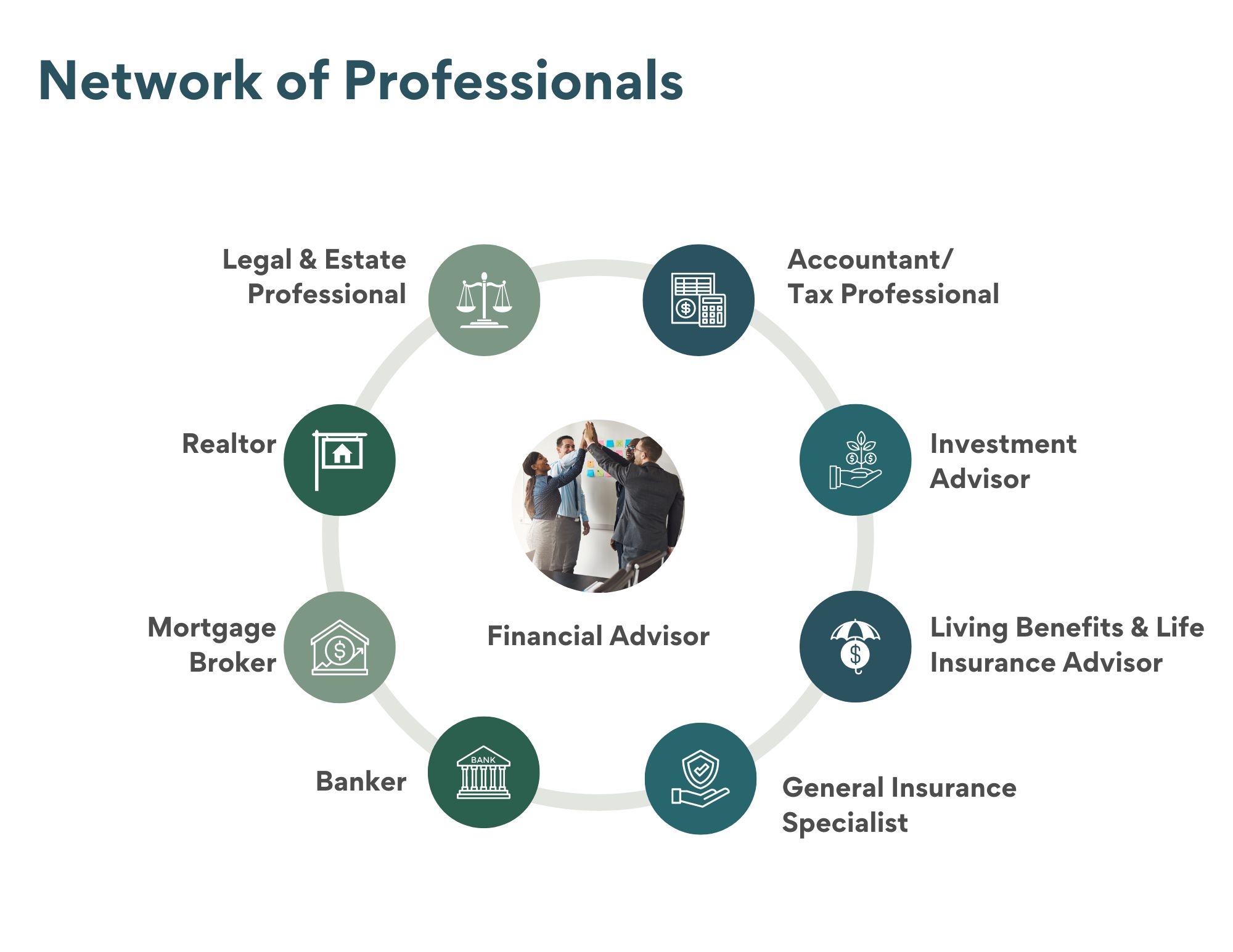
    Network of Professionals

    June 3, 2024/in Accountants, Blog, Business Owners, Center of Influences, Estate Planning, Family, farmers, financial advice, Financial Planning, incorporated professionals, individuals, Insurance, Investment, life insurance/by Crossroads Financial Inc.

    Our Network of Professionals

    As a financial advisor, my primary goal is to help you achieve financial clarity. I do this by accessing a network of dedicated professionals, each bringing their unique expertise to the table. Together, we provide personalized advice and services that help you make informed decisions and secure your future.

    Financial Advisor

    Think of me as your financial coordinator. I help you figure out your goals, create plans to achieve them, and keep everything on track. Whether it’s planning for retirement, managing investments, or saving for a major purchase, I have access to a network of professionals who ensure every aspect of your financial life works together smoothly.

    Accountant/Tax Professional

    Having an accountant or tax professional in your financial network is essential for keeping your financial records in order. They handle tasks like bookkeeping, preparing financial statements, and assisting with tax planning. Their role is particularly important during tax season. They help you file your taxes accurately and on time, taking the stress out of the process. By optimizing your tax strategies and ensuring everything is reported correctly, they help you save money. Their skills are invaluable for both your immediate needs and long-term financial planning.

    Investment Advisor

    Investment advisors focus on building and managing investment portfolios tailored to your short-term, medium-term, and long-term goals. They thoroughly research the market, evaluate investment opportunities, and offer valuable insights to help you create a well-rounded portfolio. Whether you’re saving up for a major purchase, planning for retirement, or aiming for other financial milestones, they assist in choosing the right investment vehicles, such as RRSPs, TFSAs, RRIFs, and non-registered accounts, to support your financial stability and future needs.

    Life Insurance and Living Benefits Advisor

    Life insurance and living benefits advisors are here to help you protect your greatest asset: yourself. Their job is to make sure you and your family are financially secure if unexpected events occur. These advisors walk you through different insurance options, including disability insurance, critical illness insurance, and life insurance, to find the coverage that fits your needs best. By understanding your unique situation and recommending the right policies, they provide you with peace of mind, knowing that you have a safety net in place for life’s uncertainties.

    General Insurance Specialist

    General insurance specialists cover a wide range of insurance needs, including auto, property, travel, and liability insurance. They assess your risks and recommend policies that provide the protection you need. Their advice helps you understand your options, compare quotes, and select the best policies to safeguard your assets, ensuring you are well-protected in various aspects of your life.

    Banker

    Bankers are there to help you navigate a wide range of financial services, especially when it comes to getting loans and credit products. They offer advice on securing personal loans, understanding credit options, and managing debt effectively. Whether you’re looking to finance a major purchase, consolidate debt, or build your credit, bankers provide the support and guidance you need to make informed financial decisions.

    Mortgage Broker

    Mortgage brokers assist you in securing financing for property purchases by accessing multiple lenders on your behalf. They assess your financial situation, compare mortgage products from various sources, and recommend the best options for you. With their ability to shop around and understand different interest rates, loan terms, and application processes, they ensure you get the best possible mortgage deal, making homeownership more accessible and affordable.

    Realtor

    Realtors are your go-to professionals for buying or selling property. They provide market insights, negotiate deals, and manage the legal aspects of real estate transactions. With their knowledge of local market trends and property values, realtors help you make informed decisions whether you’re purchasing a home, investing in real estate, or selling property.

    Legal & Estate Professional

    Legal and estate professionals play a vital role in your financial planning by handling the legal side of things, such as estate planning, wills, trusts, and probate. They make sure your assets are distributed according to your wishes and that all the necessary legal documents are properly set up. Their guidance helps you reduce estate taxes and smoothly navigate the legal processes, ensuring your wealth is transferred to future generations just as you intended.

    Having a network of financial professionals is essential for achieving financial well-being. Each member brings their own expertise to address different aspects of your finances, from investments and insurance to legal and real estate matters. As your financial advisor, I act as the coordinator, ensuring that all these professionals work together seamlessly. By leveraging their combined knowledge and skills, you can gain financial clarity and know that every aspect of your financial life is taken care of.

    Ready to take control of your financial future? Contact us today.

    https://crossroadsfinancial.ca/wp-content/uploads/2024/06/Network-of-Professionals-FI.png 700 1200 Crossroads Financial Inc. https://crossroadsfinancial.ca/wp-content/uploads/2020/04/websiteLogo-300x92.png Crossroads Financial Inc.2024-06-03 12:01:592024-06-03 12:21:51Network of Professionals

    Stay Ahead in 2024: A Comprehensive Checklist for Federal Tax Updates

    April 22, 2024/in 2024, Blog, Business Owners, Family, financial advice, Financial Planning, individuals, Investment, Retirees, retirement/by Crossroads Financial Inc.

    With the upcoming 2024 Canadian tax rule changes, it’s important to review your financial strategies. We’ve identified the key changes that we expect to influence financial decisions for investors, business owners, incorporated professionals, retirees, and individuals with high income or net worth.


    Capital Gains Inclusion Rate

    Starting on June 25, 2024, the tax on capital gains is changing. Until now, you would only have to include half of your capital gains in your income for tax purposes. But after that date, you’ll have to include two-thirds of any capital gains over $250,000 on your tax return. This is also the case for employee stock options. 

    Consequently, for corporations and trusts, they will have to include two-thirds of all their capital gains, no matter the amount. This is a significant change. 


    Lifetime Capital Gains Exemption (LCGE)

    The budget proposes increasing the LCGE for qualified capital gains from $1,016,836 to $1.25 million, effective for sales made after June 24, 2024. This change increases tax benefits for individuals selling certain types of property, such as small business shares or farming and fishing assets.


    Alternative Minimum Tax (AMT)
    The 2023 budget included updates to the AMT, suggesting revising the charitable donation tax credit for AMT calculations, increasing the claimable amount from 50% to 80%.


    Employee Ownership Trust (EOT)

    The budget proposes a tax exemption on up to $10 million in capital gains for individuals selling their businesses to an EOT if certain criteria are met. 


    Canadian Entrepreneurs’ Incentive

    This new tax measure offers a reduced inclusion rate of 1/3 for up to $2 million in capital gains during an individual’s lifetime, with this limit being phased in over 10 years. However, it’s important to know that not all businesses qualify—this doesn’t apply to businesses in professional services, finance, real estate, hospitality, arts, entertainment, or personal care.

    Below is a checklist to help you navigate the tax adjustments and ensure your financial plans are updated and aligned with the new rules.


    Investors

    • Investments: Evaluate portfolios to identify where capital gains can be realized under the current lower inclusion rate.

    • Investment Property: Consider advancing the sale of such properties to benefit from the existing capital gains rate.

    • Estate Planning: Revise plans to address potential increases in capital gains taxes, ensuring estates are structured for tax efficiency.

    • Employee Stock Options: Adjust the timing of exercising stock options to align with the upcoming changes in inclusion rates.


    Business Owners:

    • Corporate Investments: Assess the impact of increased inclusion rates on corporately held assets, exploring the timing of gains realization. Review trust-held investments. 

    • Lifetime Capital Gains Exemption: Maximize the benefits of the increased LCGE for qualifying business assets.

    • Employee Ownership Trust: Consider the advantages of transferring business ownership via an EOT.

    • Succession Planning: Update your succession plans to consider the potential impact of capital gains tax changes.

    • Entrepreneurs Incentive: Check if you are eligible to reduce capital gains taxes. 


    Incorporated Professionals:

    • Investments: Assess both personal and corporate investments for the new inclusion rate. Determine the most tax-effective structure for holding and realizing gains from investments.

    • Succession Planning: Time the potential sale of your professional corporation to capitalize on the current LCGE.


    Retirees:

    • Estate Planning: Update estate plans considering the impending increase in capital gains rates.

    • Life Insurance Coverage: Ensure life insurance is adequate to cover increased capital gains tax liabilities upon death.

    • Non-Registered Investments and Retirement Income: Review your strategy for non-registered investments to manage taxes on gains and adjust your retirement income plans to accommodate the upcoming changes in capital gains rates.


    Individuals with High Income or Net Worth: 

    • Investments: Evaluate portfolios to identify where capital gains can be realized under the current lower inclusion rate. Review trust-held investments. 

    • Investment Property: Consider advancing the sale of such properties to benefit from the existing capital gains rate.

    • Estate Planning: Revise plans to address potential increases in capital gains taxes, ensuring estates are structured for tax efficiency.

    • Charitable Contributions: Align your charitable giving strategies with the new tax benefits and AMT considerations.

    Please reach out to us to review your financial strategy together and ensure it aligns with the upcoming changes. 

    https://crossroadsfinancial.ca/wp-content/uploads/2024/04/Stay-Ahead-in-2024-A-Comprehensive-Checklist-for-Federal-Tax-Updates.jpg 300 500 Crossroads Financial Inc. https://crossroadsfinancial.ca/wp-content/uploads/2020/04/websiteLogo-300x92.png Crossroads Financial Inc.2024-04-22 11:02:132024-04-22 11:14:07Stay Ahead in 2024: A Comprehensive Checklist for Federal Tax Updates
    Page 1 of 3123

    Book a Meeting

    Search Blog Posts

    Search Search

    Latest News

    • What is Critical Illness Insurance?October 1, 2026 - 3:50 pm
    • Why Life Insurance Should Be Part Of Your Estate PlanningSeptember 1, 2026 - 1:30 pm
    • Financial Checklist for New Parents in CanadaAugust 6, 2026 - 12:00 pm

    Categories

    • 2020
    • 2020 Only
    • 2021
    • 2022
    • 2022 Only
    • 2023
    • 2024
    • 2025
    • 2026
    • Accountants
    • Blog
    • Budget
    • Business Owners
    • business owners
    • buy sell
    • Center of Influences
    • Charitable Gifting
    • Coronavirus
    • Coronavirus – Associates
    • Coronavirus – Practice Owners
    • Coronavirus – Practice Owners
    • Coronavirus – Retired
    • Coronavirus – Retiring
    • Coronavirus – Students
    • corporate
    • critical illness insurance
    • Debt
    • dental benefits
    • disability
    • disability insurance
    • Estate Planning
    • Family
    • farmers
    • financial advice
    • Financial Planning
    • Government Budget
    • Group Benefits
    • health benefits
    • incorporated professionals
    • individuals
    • Insurance
    • Investment
    • life insurance
    • long term care
    • mortgage
    • Ontario Only
    • pension plan
    • personal finances
    • Professional Corporations
    • Professionals
    • rdsp
    • Registered Education Savings Plan
    • Retirees
    • retirement
    • rrsp
    • tax
    • Tax Free Savings Account
    • travel insurance

    Get in Touch

    Crossroads Financial Solutions Inc.
    Tel: (905) 361- 6500
    Email: connect@crossroadsfinancial.ca
    TF: 1-877-607-6237

    4255 Sherwoodtowne Blvd, Suite 102
    Mississauga, Ontario
    L4Z 1Y5

    Latest News

    • What is Critical Illness Insurance?October 1, 2026 - 3:50 pm
    • Why Life Insurance Should Be Part Of Your Estate PlanningSeptember 1, 2026 - 1:30 pm
    • Financial Checklist for New Parents in CanadaAugust 6, 2026 - 12:00 pm

    About

    Everyone has their own dreams. Protecting those goals is our mission. We believe there is no “One Size Fits All” when it come to planning your insurance needs and investment goals.
    We encourage you to have a discovery meeting with us.

    ©2020 Financial Tech Tools Inc. | Privacy Statement and Terms of Use
      Scroll to top Scroll to top Scroll to top